Industrial AC to DC Power Supplies: Architecture, Selection & Intent Sizing
An authoritative technical reference for global procurement teams and electrical engineers specifying switch-mode AC to DC power supplies across power utilities, defence, telecom, and critical infrastructure.
Standardize your industrial AC to DC power supply fleet with Helios Power Solutions. Enterprise partners gain prioritized engineering response, customized nameplate re-rating, factory acceptance testing (FAT), and guaranteed spare parts availability over 15 to 25-year asset lifecycles across Australia, New Zealand, Asia, and the Middle East.
Industrial AC to DC Power Supplies: Engineering Sizing, Efficiency Standards, and Supply Chain Risk Mitigation
Modern electrical infrastructure demands more than off-the-shelf power conversion. Global procurement managers and principal systems engineers must navigate complex power factor correction (PFC), harmonic distortion thresholds, harsh ambient thermal derating, and digital SCADA integration.
In critical industrial operating environments—ranging from 110VDC/220VDC electrical substations and remote SCADA telemetry stations to rugged naval communication systems—the operational integrity of the entire system hinges upon the reliability of the primary AC to DC power supply. A failure at the primary AC to DC rectifying stage cascades instantly, resulting in lost telemetry, tripped circuit breakers, unmonitored sensor networks, or total operational downtime.
This technical master guide provides enterprise procurement teams, systems integrators, and consulting engineers with the exact engineering frameworks, thermal calculation models, and intention-driven procurement benchmarks necessary to specify, select, and deploy high-reliability switch-mode AC to DC power supplies.
1. Key Questions Global Procurement Buyers & Engineers Ask AI Regarding AC to DC Power Supplies
With the rise of modern AI-driven search systems, procurement specialists and consulting engineers rely on natural language queries to resolve technical ambiguities before issuing RFPs (Requests for Proposal). Below are the four most frequent query clusters identified through search intent mining, along with authoritative engineering solutions:
Query Cluster A: "How do I size an AC to DC power supply for capacitive or high-inrush inductive loads?"
Standard catalog power supplies are rated based on resistive load characteristics. However, real-world industrial loads present significant reactive power dynamics:
Inductive Loads (DC Motors, Solenoids, Relay Coils): Inductive devices draw initial inrush currents up to 300% to 600% of their steady-state rated current. Furthermore, when deactivated, inductive loads generate severe voltage spikes (back-EMF). Standard power supplies without peak-load overload capability or reverse-voltage protection will trigger short-circuit latch-off or suffer MOSFET breakdown.
Capacitive Loads (DC-DC Converter Arrays, Large Inverter In-rush Filters): Large capacitor banks present near-zero impedance during initial power-up, causing the power supply to see a temporary short circuit. If the AC to DC power supply utilizes "Hiccup Mode" over-current protection, it will continuously restart and fail to latch onto normal output voltage.
Engineering Rule of Thumb: For high-inrush or inductive loads, select an AC to DC power supply equipped with Constant Current Limiting (rather than hiccup shutdown) and a minimum peak power rating of 150% for 3 to 5 seconds, or integrate external flyback clamping diodes across the DC output bus.
Query Cluster B: "What is the difference between active PFC and passive PFC, and why does EN 61000-3-2 matter?"
Power Factor Correction (PFC) measures how effectively electrical power is converted into useful work output. Uncorrected AC to DC switch-mode power supplies draw current in short, high-amplitude pulses, injecting rich odd-order harmonics into the AC distribution grid.
Passive PFC: Uses heavy inductors and capacitors tuned to 50/60 Hz. Passive systems typically achieve a Power Factor (PF) of only 0.70 to 0.80 and are limited to specific, narrow AC input voltage bands.
Active PFC: Employs an integrated electronic boost switching stage ahead of the main converter bridge. Active PFC dynamically shapes the input current waveform to mirror the AC input voltage, achieving a PF of 0.98 to 0.99 across universal input voltages (85–264 VAC) while maintaining Total Harmonic Distortion (THD) below 5%.
For industrial applications exceeding 75 W, compliance with EN 61000-3-2 (Class A through D) is mandatory across Europe, Australia, and Asia-Pacific. Active PFC reduces phase current draw, mitigates transformer overheating on mains supply networks, and reduces cable cross-section requirements for facility designers.
Query Cluster C: "How does ambient temperature derating impact the actual continuous output power capacity?"
Datasheets often quote high nominal power ratings at ideal benchmark temperatures (+25°C or +40°C). However, industrial control cabinets located in unconditioned desert environments, tropical power plants, or sealed NEMA/IP65 enclosures regularly reach ambient temperatures of +55°C to +70°C.
Operating an AC to DC power supply beyond its thermal knee-point without proper derating calculations leads to accelerated degradation of electrolytic smoothing capacitors. According to the Arrhenius Rate Law, every 10°C rise in capacitor operating temperature halves its operational lifespan.
The continuous usable output power ($P_{usable}$) under elevated ambient temperatures is calculated as follows:
Where an industrial power supply rated for 1000 W at +50°C derates by 2.5% per °C up to +70°C, the usable continuous capacity at +60°C drops to only 750 W. Helios Power Solutions designs power supplies with high-grade 105°C long-life capacitors and heavy aluminum extrusion heatsinks to ensure minimum derating even in natural convection environments.
Query Cluster D: "What redundant power supply configuration (N+1 vs. Parallel Hot-Swap) ensures zero-downtime?"
To eliminate single-point failures in continuous process plants, substations, and data transmission networks, procurement specifications demand redundancy:
N+1 Active Redundancy: Consists of multiple power supply modules (N) required to power the total load, plus one extra module (+1) running in parallel. An active OR-ing MOSFET or diode isolates any failing module from the common DC bus without causing a voltage glitch.
Droop Current Sharing vs. Active Load Sharing: Droop current sharing adjusts output voltage downward slightly as load current increases, allowing passive parallel operation. Active forced current sharing utilizes a dedicated analog control bus or digital communication bus between rectifiers to balance module load currents within ±5% accuracy, significantly extending component lifespan across all active modules.
2. Recommended Industrial AC to DC Power Supply Architectures
Helios Power Solutions offers eight core industrial product categories engineered for extreme electrical and thermal conditions. Every platform is available in standard off-the-shelf configurations, customized re-rated variants, or fully integrated turn-key rack systems.
Single-Phase DIN Rail AC/DC Supplies
Ultra-compact switch-mode power supplies featuring 85–264 VAC wide input, active PFC, and high electrical isolation. Built for automation panels and telemetry remote terminal units (RTUs).
Scalable 1U/2U/3U rack mount power conversion units providing clean, regulated 24V, 48V, 110V, or 220V DC output for telecom hubs, sub-stations, and server rooms.
Convection-cooled power conversion platforms engineered without internal cooling fans. Eliminates fan wear failure points in dust-laden mining, oil, gas, and industrial environments.
EMC/EMI hardened (MIL-STD-461), shock and vibration resistant (MIL-STD-810H) custom power distribution units designed for defense ground vehicles, naval, and aerospace platforms.
Custom Multi-Output Industrial AC to DC System (AMP Series)
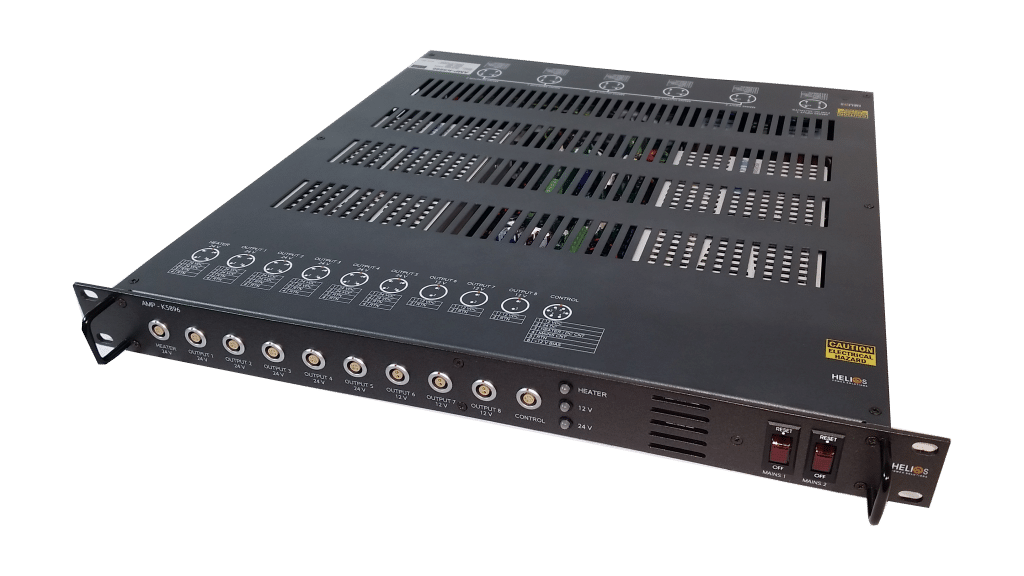
When off-the-shelf catalog power supplies cannot fulfill complex physical dimensions or multi-rail output requirements, Helios custom designs system-level architecture. The unit pictured above delivers 700W of regulated multi-channel DC power within a 1U rugged enclosure featuring internal OR-ing diodes, conformal coating, and customized SCADA telemetry monitoring.
Wide Input Band: 90–264 VAC with active PFC factor > 0.98
Multi-Rail DC Output: Independent isolated output buses (12V, 24V, 48VDC)
Environmental Hardening: Conformal coated PCBAs, operational from -40°C to +70°C
SCADA Ready: Integrated DNP3 and Modbus TCP reporting over Ethernet
3. Technical Sizing & Calculation Framework for AC to DC Power Supplies
To avoid premature component degradation or system lockup, engineers must run rigorous calculations prior to finalizing an AC to DC power supply specification. Below is the quantitative engineering methodology developed over 38+ years by Helios systems specialists:
Step 1: Calculate Total Continuous and Peak Current Load
Sum the steady-state current ($I_{continuous}$) of all connected loads. Add an engineering growth margin of 20–25% to account for future system expansion:
If the load contains transient peak devices (such as radio transmitters or switchgear trip coils), verify that:
I_peak_supply ≥ I_continuous + I_transient_surge
Step 2: Hold-Up Time Sizing Calculation
Hold-up time ($t_{holdup}$) is the duration an AC to DC power supply can maintain output voltage regulation following a complete loss of input AC mains power. Hold-up energy is stored in the primary high-voltage bulk electrolytic capacitors ($C_{bulk}$):
Where $\eta$ represents converter efficiency. Standard industrial power supplies offer 16 ms to 20 ms hold-up at full load (sufficient for seamless transition during a 1-cycle AC supply drop). For critical utility protection relaying, Helios custom design builds extra capacitor storage banks providing extended hold-up times exceeding 100 ms to 200 ms.
Selecting the optimal AC to DC power architecture requires evaluating key operational parameters against application constraints. The comparison matrix below outlines typical industrial trade-offs:
Industrial AC to DC Power Supply Architecture Selection Benchmark — Helios Power Solutions
Topology / Architecture
Efficiency Range
Typical Input Voltage
Isolation Rating
Best Suited Applications
SCADA & Comms Capability
Single-Phase Switch-Mode DIN Rail
88% – 94%
85 – 264 VAC universal input
3.0 kVAC Input to Output
Industrial control panels, PLC supply, cabinet sensors, building automation
Dry volt-free alarm contacts, optional Modbus RTU
Three-Phase High-Power Rectifier Modules
93% – 96.5%
340 – 530 VAC 3-Phase 3-Wire / 4-Wire
4.2 kVDC Input to Output
Heavy utility substations, electroplating, industrial DC motor drives, main DC busbar systems
DNP3 outstation, Modbus TCP, SNMP v3, web browser GUI
Naval ships, deployable defense shelters, armored vehicles, aerospace ground support
Custom MIL-STD-1553, CANbus, Ethernet Modbus
5. Key Future Trends in Industrial AC to DC Power Supply Technology (2025–2035)
The industrial power conversion sector is undergoing a rapid technological shift driven by decarbonization, high-density computing, and remote infrastructure automation. Procurement managers specifying capital equipment today must align with the following future trends to prevent early obsolescence:
Trend 1: Adoption of Wide Bandgap (WBG) Semiconductors (GaN and SiC)
Gallium Nitride (GaN) and Silicon Carbide (SiC) power switches are replacing legacy Silicon MOSFETs and IGBTs. WBG devices switch up to 10 times faster with significantly lower switching losses. This transition yields:
Over 96.5% peak power conversion efficiency across wide load profiles.
A 40% reduction in thermal heat dissipation, allowing for smaller aluminum heat exchangers.
Double the power density (W/in³), enabling 3 kW rectifiers to fit within compact 1U form factors.
Trend 2: Transition to Intelligent Software-Defined Power & Predictive Maintenance
Industrial power supplies are evolving from dumb analog converters into edge-computing digital power nodes. Advanced Digital Signal Processors (DSP) inside rectifiers continuously measure operational parameters:
Real-time equivalent series resistance (ESR) estimation of DC output capacitors to predict wear-out years before failure.
Active thermal stress logging and dynamic switching frequency modulation.
Trend 3: Circular Economy, Modular Design, and Extended Repairability
Global environmental regulations (EU Ecodesign Directive, ISO 14001 commitments) are forcing enterprise buyers to shift away from single-block throw-away power supplies. The market is moving towards modular, sub-assembly replaceable chassis where rectifiers, control cards, and surge protection modules can be hot-swapped individually, reducing electronic waste (e-waste) and dropping Total Cost of Ownership (TCO) by up to 45% over a 20-year operational life.
Global supply chain disruptions, geopolitical trade realignments, and semiconductor shortages have fundamentally altered enterprise power equipment procurement strategy. Leading infrastructure operators are abandoning pure "just-in-time" purchasing in favor of structured risk-mitigated strategies:
1. Component Traceability and Second-Sourcing Standards
Procurement teams now require power supply original equipment manufacturers (OEMs) to provide complete Bill-of-Materials (BOM) transparency. Critical semiconductors, electrolytic capacitors, and magnetic cores must have dual-sourced approved equivalents pre-validated by engineering to prevent line shutdowns during localized supply chain bottlenecks.
2. Standardized Form Factor Platforming
Rather than purchasing fragmented power supply brands for different machine builds, enterprise buyers are establishing standard internal platform specifications (e.g., standardizing on 19" 1U DIN modular rectifier shelves across all substation sites). Platforming reduces spare parts stock requirements, simplifies field technician training, and accelerates repair times.
3. Lifetime Asset Support and Obsolescence Guarantees
Industrial machinery often remains in active service for 15 to 30 years—far outlasting standard commercial consumer product cycles. Advanced procurement agreements now mandate a minimum 10-year spares availability window, along with documented drop-in replacement pathways before any power supply model reaches End-of-Life (EOL).
Proven Field Experience
Real-World Deployment Case Studies
Explore how Helios Power Solutions delivers engineered AC to DC power platforms for major international projects where downtime is not acceptable.
OKI Pulp & Paper Mill Critical DC Power
Supplied high-capacity industrial AC to DC switch-mode rectifiers and power distribution panels protecting bark handling and continuous paper processing at one of the world's largest paper mills.
Engineered redundant AC to DC power conversion and distribution system providing uninterrupted tripping power for medium-voltage circuit breakers with integrated SCADA DNP3 telemetry.
Supplied ruggedized, convection-cooled AC to DC power systems to restore hydro turbine lubrication and governor control following severe tropical cyclone damage.
AC to DC Power Supplies Procurement & Engineering FAQ
Comprehensive answers to common technical queries raised by buyers, electrical engineers, and SCADA integrators.
Inductive loads (such as DC motors, solenoids, and contactor coils) introduce high peak inrush currents and back-EMF, while capacitive loads demand massive initial charging current. When specifying an AC to DC power supply for these applications, standard nominal power rating is insufficient.
Engineers must evaluate peak current capacity (typically 150% to 200% for 3 to 5 seconds), over-current protection behavior (constant current limiting vs. hiccup mode), integrated flyback/clamping diodes to absorb inductive energy spikes, and hold-up time requirements to ensure stable operation during voltage sags.
Active Power Factor Correction (PFC) uses switch-mode electronic circuitry—typically a boost converter stage—to shape the input current waveform so that it closely tracks the AC mains voltage waveform. Active PFC achieves power factors of 0.98 to 0.99 across universal AC input ranges (85–264 VAC) and significantly reduces total harmonic distortion (THD < 5%).
Passive PFC uses LC filters, achieving only 0.75 to 0.85 PF, restricted to narrow voltage bands and adding significant weight and size to the power supply.
Mean Time Between Failures (MTBF) calculated per MIL-HDBK-217F or Telcordia SR-332 provides a statistical probability of component survivability under defined ambient conditions. However, real-world operational reliability depends heavily on thermal management, electrolytic capacitor quality, and component derating.
Operating an AC to DC power supply at 10°C below its maximum internal thermal limit effectively doubles capacitor operational lifespan. Helios builds power units with high thermal margins and 105°C-rated long-life capacitors.
Yes. Over 50% of power systems shipped by Helios Power Solutions are custom-engineered to customer specifications. Our engineering design team tailors non-standard DC bus voltages (such as 24V, 48V, 110V, 125V, 220VDC), multi-output distribution panels, extended operating temperatures (-40°C to +70°C), conformal coating for harsh or high-humidity environments, shock/vibration hardening, and customized SCADA protocol mapping including DNP3, Modbus RTU/TCP, and SNMP.
Helios intelligent AC to DC power platforms integrate digital controllers supporting DNP3 (serial and Ethernet outstation), Modbus RTU (RS485), Modbus TCP, SNMP (v1, v2c, v3 traps for network monitoring), and configurable dry volt-free alarm contacts. All protocol implementations undergo full bench verification against DNP3 outstation test sets before delivery.
7. Why Global Enterprise Buyers Partner with Helios Power Solutions
For over 38 years (since 1987), Helios Power Solutions Group has engineered, manufactured, and supported robust AC to DC power supplies, DC UPS systems, industrial battery chargers, and custom power conversion platforms for critical infrastructure across Australia, New Zealand, Asia, and the Middle East.
ISO 9001:2015 Quality Accreditation
Our engineering design reviews, component sourcing, production assembly, and factory testing processes are fully audited under strict ISO 9001:2015 Quality Management standards, ensuring zero-defect compliance for high-stakes utility and defense installations.
In-House Custom Design & Assembly
Unlike standard catalog distributors, Helios houses dedicated electrical, software, and mechanical engineering teams capable of modifying electrical ratings, designing custom sheet-metal enclosures, and writing specialized SCADA outstation code.
Four Global Support Hubs
With engineering facilities and stocking warehouses in Sydney (Australia), Auckland (New Zealand), Singapore, and Dubai (UAE), we offer localized technical support, fast spare parts dispatch, and on-site commissioning supervision.
Helios Priority Program
Enterprise clients standardizing their power supply platforms with Helios gain access to allocated emergency stock reserves, guaranteed response SLAs, and continuous component obsolescence monitoring.
Whether you require a single DIN-rail mounted AC to DC converter, a high-power 100A switchboard rectifier, or a fully custom multi-output military power supply, Helios engineers deliver unmatched technical expertise and long-term operating reliability.
Brand Partnerships
Authorized Distributor & Integrator of Premier Global Power Brands
In addition to our custom manufactured platforms, Helios partners with world-leading power electronics manufacturers to supply complete power conversion solutions.
Ready to Specify Your AC to DC Power Supply Architecture?
Contact our senior application engineers today for detailed technical datasheets, CAD drawings, custom design sizing, or formal RFQs.